
Choosing between residential and datacenter routes is not a performance decision dressed up as an infrastructure one. It is a decision about which kind of connection the destination should see. Speed, price, stability and tolerance all follow from that single property, which is why the comparison collapses so often into an unhelpful argument about which type is “better”.
This article separates the two network identities on the terms that actually differ: where the address comes from, how the destination is likely to treat it, what each costs per useful result, and how mature teams split a workload across both instead of picking a side.
The difference is registration, not quality
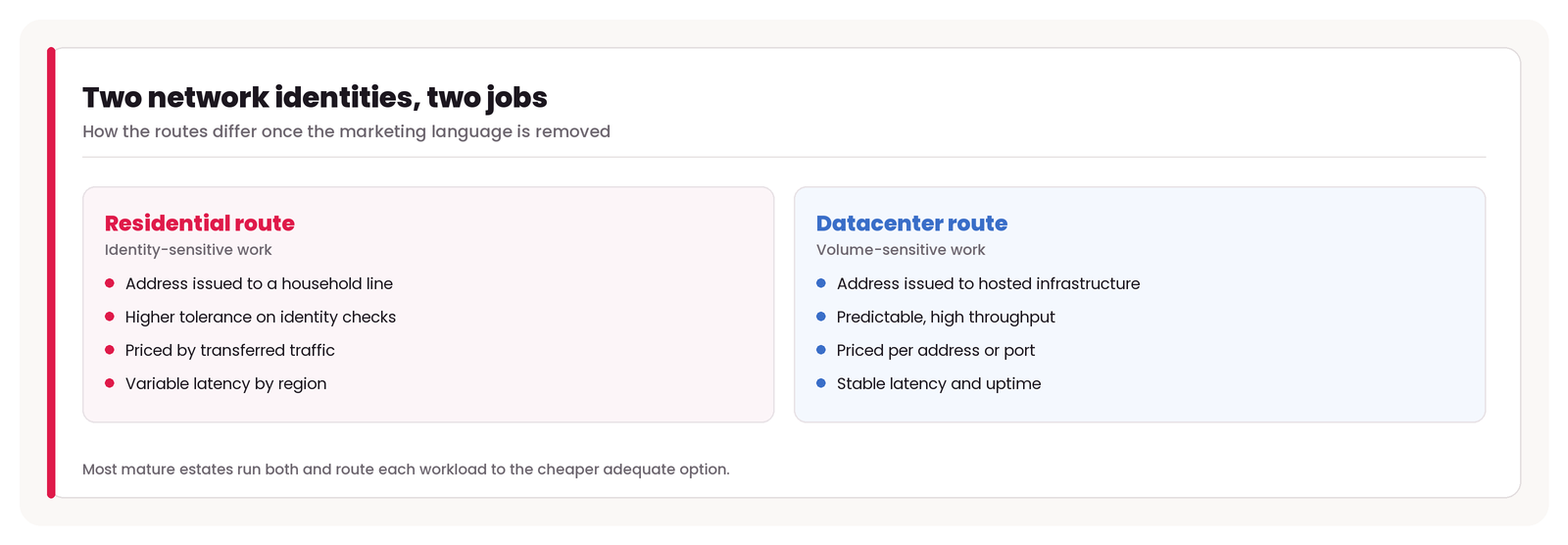
A residential address is one an internet service provider allocated to a household line. A datacenter address belongs to a hosting or cloud provider and is registered to commercial infrastructure. Both can be fast, both can be reliable, and neither is inherently cleaner than the other. What differs is the public registry record attached to the range, and the assumptions a destination is entitled to draw from it.
Those assumptions are why the same request can succeed on one route and be refused on the other without anything about the request changing. A site that treats hosted ranges as automation by default is not making a judgement about your intent; it is applying a rule to a registry class. Understanding that keeps the evaluation factual rather than adversarial.
Where each route earns its cost
Datacenter capacity is bought in bulk from infrastructure the provider controls end to end, so it is cheap, consistent and easy to scale. Latency variance is low, uptime is contractual, and throughput is limited mainly by what you are willing to pay for. For volume work against destinations that do not differentiate by registry class, it is difficult to beat.
Residential capacity is borrowed from consumer connections the provider does not own, which makes it more expensive per gigabyte, more variable in latency, and subject to whatever the participating household is doing at the time. What it buys is a registry record that looks like an ordinary subscriber, which is the entire point for identity-sensitive work such as regional page rendering, advertising verification and localisation checks.
| Property | Residential route | Datacenter route |
|---|---|---|
| Address origin | Issued by a consumer ISP to a household | Issued to hosted infrastructure |
| Usual billing unit | Transferred gigabytes | Address or port per period |
| Latency profile | Variable, depends on the household line | Low and predictable |
| Concurrency ceiling | Limited by pool depth in the region | Limited by purchased capacity |
| Best suited to | Identity-sensitive verification | High-volume neutral collection |
Test the assumption before paying the premium
The premium on residential traffic is only worth paying where the destination actually differentiates. Establishing that takes an afternoon: run the same modest sample against the same target list on both route types, at the same hour, and compare the useful-response rate rather than the raw status codes.
- Run both routes against an identical target list, not against representative samples chosen separately
- Compare responses that contain the data you need, not responses that merely returned a status
- Repeat the run in a second time window before drawing a conclusion
- Record the result per destination, because behaviour rarely generalises across a whole sector
- Re-test after any visible redesign, since registry treatment is changed without announcement
Most mature estates run both
The framing that saves money is not residential versus datacenter but which workload belongs on which route. Catalogue crawls, sitemap discovery, robots parsing, uptime checks and internal endpoints rarely need residential identity at all, and moving them onto cheaper infrastructure frequently pays for the residential budget covering the work that does.
The routing decision belongs in configuration, tied to the destination rather than to the job, so a target can be promoted or demoted between route types without touching the collector. Teams that hard-wire the choice find themselves running everything on the more expensive route because reclassifying is awkward.
Static residential sits between the two
Static residential and ISP products hold an address that carries consumer registration while behaving like hosted infrastructure in every operational sense: stable, reserved for you, and priced per address rather than per gigabyte. They suit approved recurring work where a destination is entitled to recognise the same visitor over time, and where a rotating pool would look inconsistent rather than ordinary.
The trade is capacity. A handful of reserved addresses cannot spread volume the way a pool can, so static products belong to narrow, identity-stable workloads rather than broad sweeps. Where a job needs both breadth and recognisability, it usually needs splitting into two jobs.
Questions that settle the choice quickly
Does the destination differentiate at all?
If a cheap route returns the same content at the same rate, the premium buys nothing and the decision is already made. This single test resolves more route arguments than any amount of vendor comparison.
Does the workload need a stable identity?
Recurring, approved access that a destination expects to recognise points at static residential. One-off breadth points at a rotating pool. Neutral bulk work points at datacenter capacity.
What is the cost per useful record on each?
Convert both quotes into the same denominator before comparing. A residential gigabyte that returns twice as many usable records as a datacenter gigabyte is not the more expensive option, whatever the unit rate says.
Review the split on a schedule
Registry treatment is not static. Destinations tighten and relax their handling of hosted ranges in response to their own load and their own incidents, and a workload that needed residential identity last quarter may not need it now. A quarterly re-test across the target list is cheap and occasionally moves a meaningful share of traffic to a cheaper route.
Keep the results in the same document as the routing configuration. When somebody asks why a particular destination is on the expensive route, the answer should be a dated measurement rather than a recollection of how things were when the pipeline was built.
Read a refusal before you change the route
When requests start failing, the reflex is to move the workload onto residential capacity and see whether the problem disappears. That sometimes works and almost always obscures the cause. A refusal driven by registry class looks different from one driven by request rate, and different again from one driven by a missing header or an expired session, yet all three arrive as an unhelpful status code.
Separate them before spending. Hold the route constant and halve the request rate: if the failures clear, the issue was volume rather than identity. Hold the rate constant and change only the route: if the failures clear, registry class was the factor. Running both experiments takes less time than migrating a pipeline and produces an answer that survives the next incident.
Model the cost of a split estate honestly
A two-route estate has costs a single-route estate does not: two sets of credentials, two billing relationships, a routing table that has to be maintained, and an on-call engineer who needs to understand both. Those costs are real but bounded, and they are usually recovered within a month by the traffic moved off the expensive route.
Model it plainly. Take the current monthly figure, identify the proportion of destinations that showed no differentiation in testing, and price that share on datacenter capacity. If the saving does not clearly exceed the operational overhead, stay on one route and revisit after the next growth step. Complexity adopted without a margin is complexity that gets abandoned halfway.
Route selection, condensed
- Classify targets by identity sensitivity
- Benchmark both route types side by side
- Cost the split rather than the premium alone
- Document which workload uses which route
- Schedule a quarterly re-test